(Antonio V. Franco)
“But how will my child get into good universities without going through a private school?”
Well, we know that, in Brazil, the system for getting into a university (UNIVERSITY; not some diploma mill) is not exactly the fairest thing in the world. However, whether you are a child from Generations Alpha or Beta who is still in school, a teenager finishing high school, or an adult studying for entrance exams, get this into your head: knowledge has become a commodity.
Studying at an elite school will, yes, continue to be an advantage in preparation, but for a smaller share of students than it was up to 2025.
Nowadays, students have access to top-level tools and materials to prepare at a high level for whatever entrance exam they are taking, regardless of whether we are talking about a student from Jardim Anália Franco or, a little farther east, from Guaianases. The taste for studying, the hunger for learning, is increasingly becoming a major determining factor in whether a student gets into university.
That is: tools and materials are abundant; what matters now is something no private school can provide: the hunger for knowledge.
And yes, I know many people who went through excellent schools and the result was nothing more than a complete waste of their parents’ money.
In this article, I present an analysis, based on machine learning, that algorithmically illustrates what I am arguing.
The silent turning point#
For a long time, studying at a private school seemed almost like an entry password to good universities. Not by magic, of course. Private schools offered structure, routine, better teachers, more organized materials, mock exams, tutoring sessions, social pressure, a competitive environment, and, above all, direction.
The student did not have to figure out alone what to study, how to study, where to start, which exam to prioritize, or which mistake to fix. The school put all of that on a conveyor belt.
The problem is that this conveyor belt, today, is no longer exclusive to those who pay expensive tuition.
The internet turned studying into something distributed. The class that used to be locked inside an expensive school classroom is now on YouTube. The exercise list that used to come in a prep course booklet is now in a PDF. The explanation that used to depend on one specific teacher can now come from five different teachers, each explaining the same topic in a different way, until it finally gets into the student’s head.
And that changes the game.
Not because private school no longer has value. It still does. But because its relative value is decreasing. The student who knows how to study, who has hunger, who knows how to use the tools available, and who understands what is at stake is slowly taking away from private schools what they had that was most powerful: the monopoly on preparation.
What the data shows#
Now, the numbers.
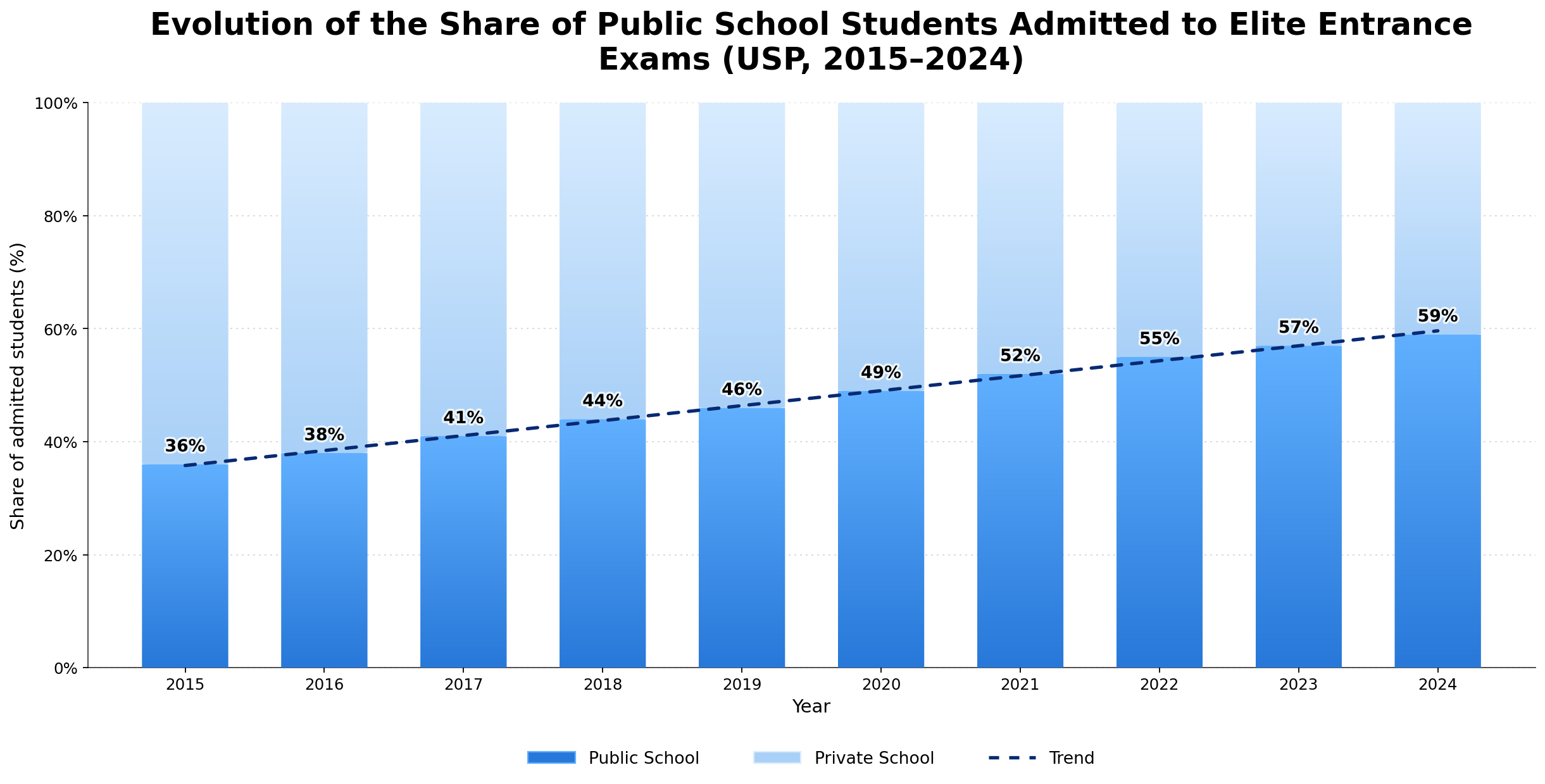
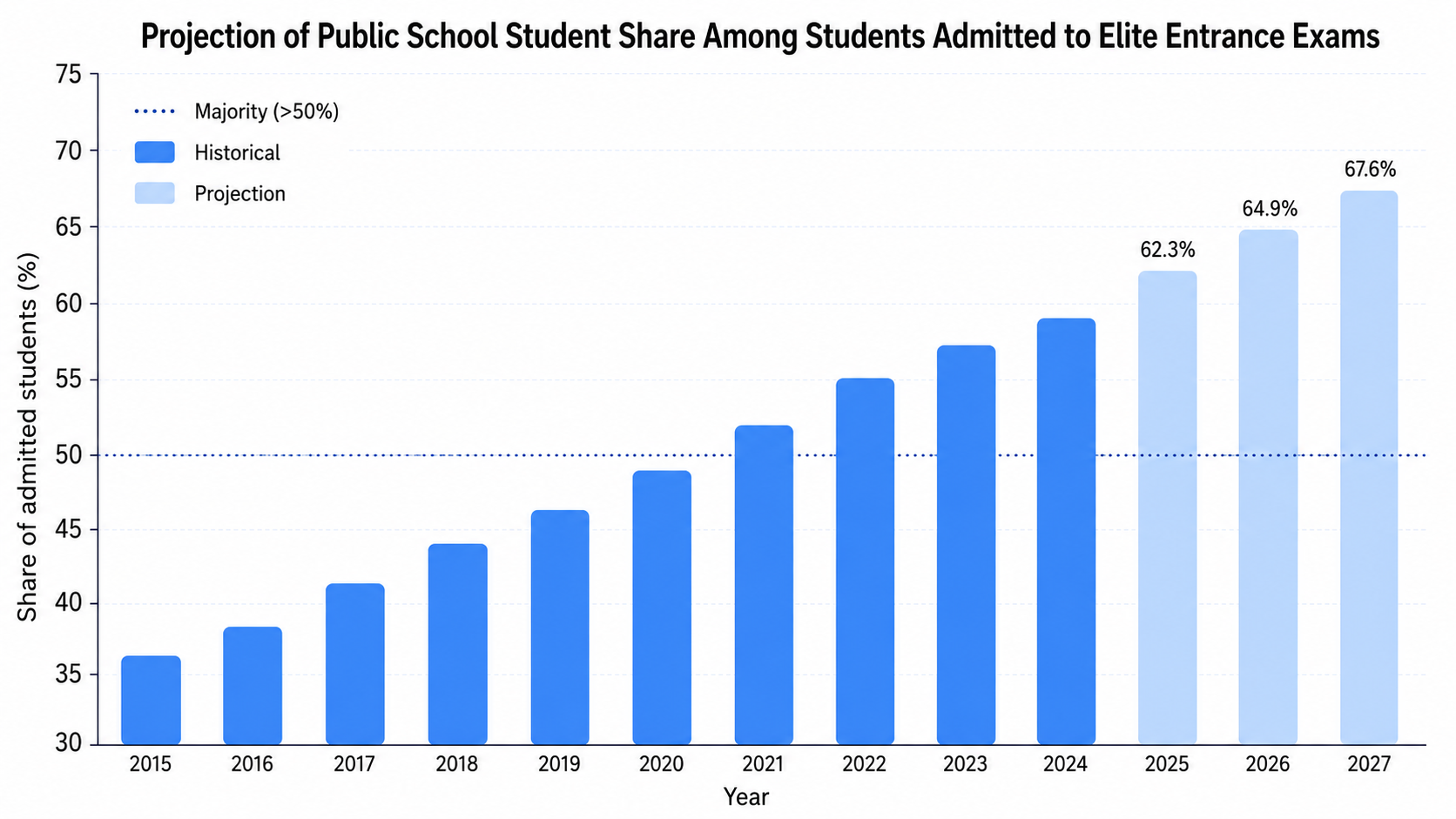
Between 2015 and 2024, the share of students from public schools among those admitted to elite entrance exams went from 36% to 59%. In other words: in less than a decade, there was an increase of 23 percentage points.
This is not a small thing.
We are not talking about a small fluctuation, statistical noise, an atypical year, or a convenient coincidence. We are talking about a clear, progressive trend that is difficult to ignore.
(Antonio V. Franco)
And here comes an important point: when I say that knowledge has become a commodity, I am not saying that all students now have exactly the same conditions. It would be stupid to claim that. A student who studies in peace, eats well, sleeps well, lives close to school, has a structured family, and can make mistakes without life collapsing on their shoulders still has real advantages.
What I am saying is something else: the gap between those who have access to content and those who do not has shrunk dramatically.
Before, the problem was: “where do I find a good class?”
Today, the problem is: “which of the 500 good classes available should I watch?”
It sounds like a detail. It is not.
The gap is shrinking#
Another piece of data that reinforces this thesis appears in the ENEM.
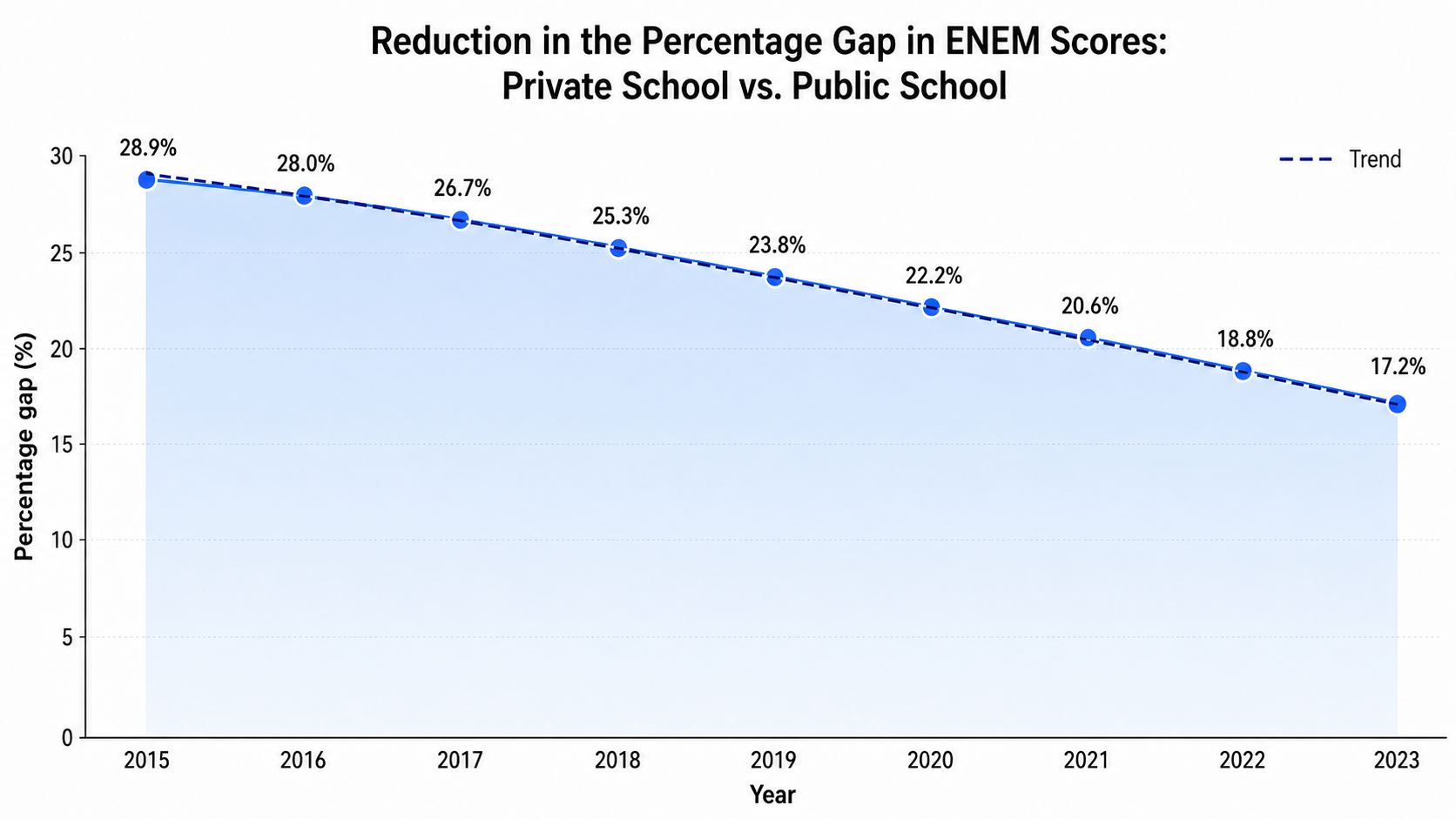
The percentage difference between the average scores of private school and public school students fell from 28.9% in 2015 to 17.2% in 2023. In other words: the abyss still exists, but it is shrinking.
(Antonio V. Franco)
And here it is worth being careful with a lazy interpretation.
No, this does not mean that Brazilian public schools have become wonderful. They have not. There are still schools without structure, overworked teachers, abandoned students, overcrowded classrooms, violence, dropout rates, learning gaps, bureaucracy, and the whole package of problems that any minimally honest person knows exists.
But you also cannot pretend that nothing has changed.
Public school students today can access outside school what the school itself often fails to provide inside it. They can study math with a teacher from Ceará, essay writing with a teacher from São Paulo, history with a specialized channel, biology through simulations, physics with step-by-step solutions, English with an app, sociocultural references with podcasts, and so on.
And when that student has discipline, private school stops being the only possible path.
The uncomfortable correlation#
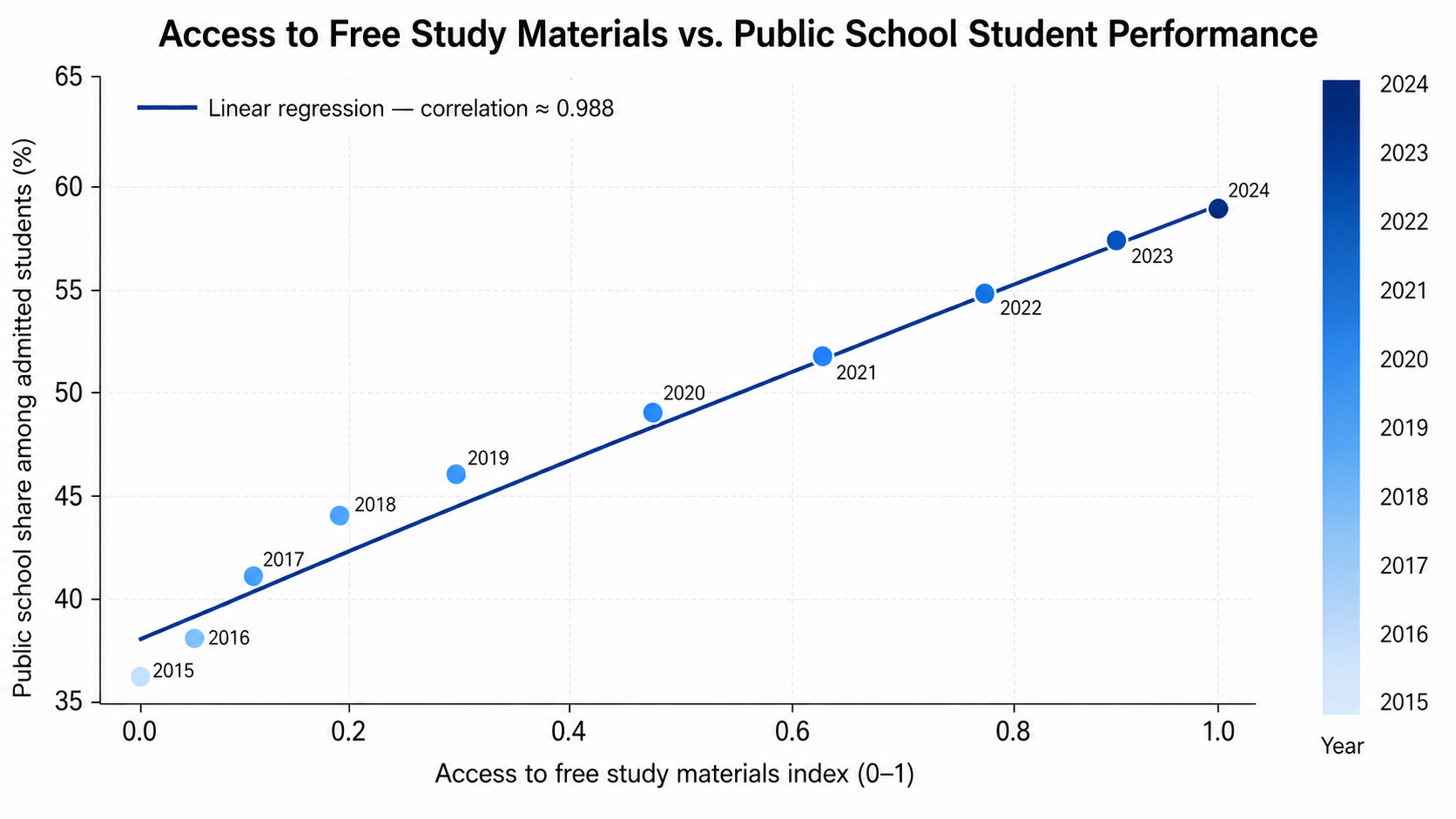
When we cross the increase in access to free materials with the performance of public school students in entrance exams, the correlation is strong: approximately 0.9877.
Translation for those who do not care about statistics: the greater the access to free study materials, the greater the tendency for public school students to make up a larger share of those admitted.
(Antonio V. Franco)
Of course: correlation alone is not a divine sentence. Just because two curves move together does not necessarily mean that one caused the other. But it would also be naive to pretend that this relationship says nothing.
When you see, at the same time, the expansion of free materials, the decline in the ENEM gap, and the increase in the presence of public school students among those admitted, the story starts to become quite coherent.
Not perfect. But coherent.
And, in plain English: the barrier to entry has fallen.
What actually changed#
What changed was not merely the existence of free content. Free content has always existed to some degree. What changed was its quality, scale, and ease of access.
Today, a student can build an entire preparation routine without paying for a prep course. They can watch classes, download exercise lists, correct essays with the support of tools, participate in communities, solve old exams, follow a schedule, simulate performance, and review content.
All of this was much harder not long ago.
Between 2015 and 2024, there was an explosion in access to online educational materials:
In 2015, for example, the scenario was different: internet access at 65.2%, Khan Academy with around 125 thousand Brazilian users, popular prep courses reaching approximately 85 thousand students, and educational YouTube at around 450 million annual views.
In 2020, the leap was already evident: internet access at 88.2%, Khan Academy reaching 950 thousand Brazilian users, popular prep courses reaching 245 thousand students, and educational YouTube with something around 1.85 billion annual views.
By 2024, things had reached another level: internet access at 96.5%, Khan Academy with 2.18 million Brazilian users, popular prep courses reaching 510 thousand students, and educational YouTube surpassing 4 billion annual views.
Khan Academy went from 125 thousand Brazilian users in 2015 to more than 2 million in 2024. Educational YouTube went from 450 million annual views to more than 4 billion.
And that is not even counting online popular prep courses, study groups, Discord servers, summaries, math and science channels, essay-writing communities, open classes, shared materials, free platforms, and, more recently, the use of artificial intelligence as a study aid.
The question stopped being “is there material available?” and became “do you have the discipline to use the material available?”
The matrix makes the pattern clearer#
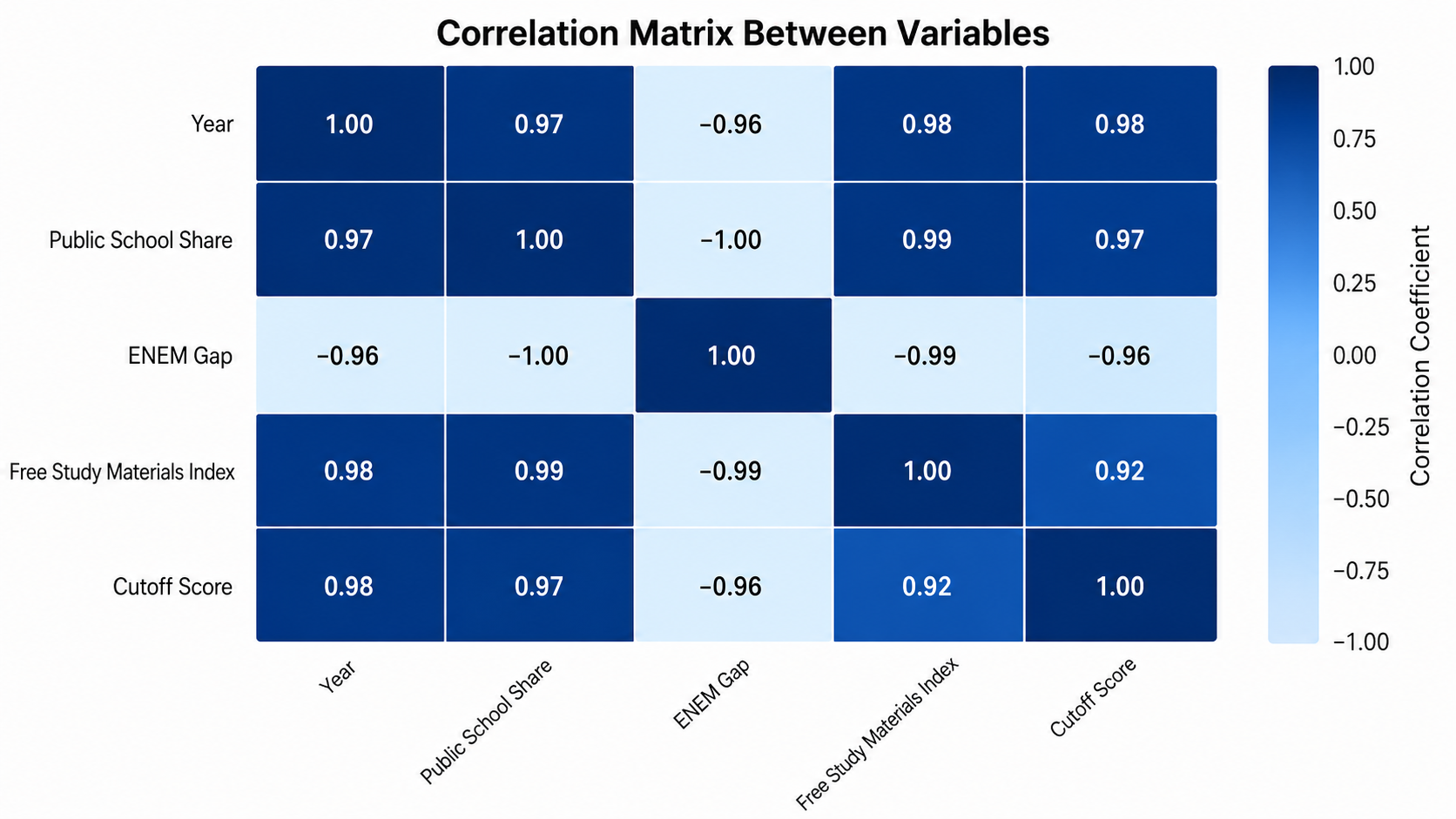
When we place the variables side by side, the pattern becomes even more evident.
Year is positively related to the share of public school students among those admitted. Year is negatively related to the ENEM gap. Access to free materials is strongly related to public school students’ performance.
(Antonio V. Franco)
In simple terms: as time goes by and as access to materials improves, the historical advantage of private schools decreases.
It does not disappear overnight. Let us not be childish.
But it decreases.
And decreasing, in this case, is already huge.
The projection#
If the trend continues, the projection indicates that public school students may represent 62.3% of those admitted in 2025, 64.9% in 2026, and 67.6% in 2027.
This means that the elite of Brazilian entrance exams may be progressively ceasing to be an almost exclusive club of those who were able to pay expensive tuition.
And, honestly, that bothers a lot of people.
It bothers them because it dismantles a comfortable narrative: that academic success is almost always bought. Does the purchase of advantage still exist? Yes. A lot of it. But it is no longer as absolute as it once was.
Today, the disciplined, curious, hungry student has more ammunition than ever before.
What this means for you, father or mother#
If you are poor, or even in that squeezed middle class that is always doing the math just to make the month close, and you are killing yourself to pay for a private school because you believe this is your child’s only chance of getting into a good university, perhaps it is time to rethink things.
I am not telling you to throw your child into any school and leave everything in God’s hands.
I am saying that perhaps the best financial decision is not to pay a tuition fee that swallows half the family’s income, but rather to build around your child a minimal and intelligent study structure.
Good internet. A decent computer. A quiet corner. Good materials. Routine. Accountability. Presence. Encouragement. And, above all, a family culture that treats studying as something serious.
Because, in the end, no school injects hunger for knowledge into the head of a student who wants nothing.
And no school holds back a student who has truly decided to move forward.
What private schools still offer#
I am not naive.
Good private schools still offer a lot: organization, structure, selected teachers, frequent mock exams, guidance, a competitive environment, networking, extracurricular activities, and safety.
That has value.
The question is: how much is it worth? And, above all, for whom is it worth it?
For a rich family, perhaps the discussion does not even exist. They pay and that is it. The money leaves the account the same way they pay for the gym, streaming, and condominium fees.
Now, for a family that has to choose between tuition, rent, food, transportation, healthcare, and some minimal emergency savings, the conversation is different.
In that case, putting a child in a private school may not be an investment. It may be vanity disguised as sacrifice.
It may be the father and mother buying psychological relief: “we did our part.”
But doing your part does not necessarily mean paying for the most expensive school you can afford. Sometimes, doing your part means stopping the outsourcing to an institution of what needs to begin at home: discipline, accountability, routine, and valuing education.
The waste nobody likes to admit#
Everyone knows some case like this.
A family that squeezed itself for years to pay for private school. Cut leisure, postponed plans, took on debt, lived on the edge. The child, meanwhile, spent years dragging everything along, studying the minimum, treating school as an annoying obligation, complaining about teachers, ignoring mock exams, and using the phone as an extension of the arm.
Result: the family bought access, but did not buy willingness.
And this is the central point.
The school can offer a path. It can offer structure. It can offer accountability. It can offer an environment.
But it cannot study in the student’s place.
From now on, the difference will be less and less “who paid for the most expensive school?” and more and more “who had more consistency?”
The new elite of entrance exams#
The new elite of entrance exams will not be made up only of those born into comfort. It will be made up, in large part, of those who understood that the game has changed.
The public school student who wakes up early, takes the bus, comes home tired, and still sits down to study has something that many expensive schools cannot manufacture: a sense of urgency.
They know that a public university is not a decorative item on a résumé. It is not an interesting experience. It is not one option among many.
Often, it is the bridge.
And when a student understands that university is the bridge, they study differently.
I do not romanticize poverty. For God’s sake. Being poor does not automatically make anyone virtuous, hardworking, or deserving. Poverty gets in the way, exhausts, limits, sickens, and steals time.
But when real willingness is combined with accessible tools, the game becomes less impossible.
And that is what the data is beginning to show.
Conclusion#
If you are poor, do not put your child in a private school just because someone put it in your head that this is the only path.
It is not.
Invest in study structure. Invest in internet. Invest in good materials. Invest in routine. Invest in presence. Invest in food. Invest in mental health. Invest in an environment where studying is treated as something important, not as a detail.
And, above all, teach your child that knowledge is not decoration. Knowledge is a weapon.
The tools are there. Free, accessible, and getting better and better.
What is missing now is hunger.
I am Antonio V. Franco, a Fuvest entrance exam student and a Solo Researcher in AI focusing on RAG, LLMs and SLMs, agents, astronomy, astrophysics, machine learning in general, mathematics, and quantum computing and mechanics. If you have any questions about my articles or if you would like to get in touch with me for any other purpose, I will be happy to talk via email: contact@antoniovfranco.com